Through his research project entitled Michelangelo and Paper as Palimpsest, Mauro Mussolin, professor at the Scuola Normale Superiore di Pisa and New York University Florence, investigated the sources of Michelangelo’s graphic work as well as the lifecycle and uses of paper in the studios of Italian Renaissance artists. Arguing that Michelangelo’s use of paper was indissolubly linked to the genesis of his ideas, he has used ultra-violet light and digital photography to reveal previously unknown sketches executed in stylus, which are invisible in conventional reproductions.
Jack Matlock has applied decades of experience with the US Foreign Service towards questions in public policy today, including lessons for leaders in his Fulbright Distinguished Lecture, titled “Managing the Crisis in Ukraine and Elsewhere,” held at Pembroke College, University of Oxford on June 12, 2015. Stream Matlock’s full lecture online at the University of Oxford’s Website.
Jack F. Matlock Jr. served as the United States Ambassador to Czechoslovakia (1981-1983) and the United States Ambassador to the Soviet Union in the later years of the Cold War (1987- 1991). Since leaving the State Department, he has served as Professor at Columbia University (1991-1996), the Institute of Advanced Study (1996-2001) and held visiting appointments at Princeton University, Columbia University, Mount Holyoke College and Hamilton College.
New Zealander Georgie Archibald has begun her two-year Master’s program in English at the University of Colorado Boulder, where she plans to focus her research on the effects of digital media on reading and writing practices. Her award will help offset the cost of books and software necessary for her project.
A photographer interested in the intersections of art and science, Clare Benson (Central Michigan University) worked with Sámi filmmaker Hans-Olof Utsi and the Swedish Institute of Space Physics—both in Kiruna, Sweden—in exploring the intersection of current astronomical investigations and ancient traditions and mythologies of indigenous Sámi culture. With her award she developed an inclusive event organized around the human relationship to the sky, sun, and universe, and returned to Sweden the following year with support from the American Scandinavian Foundation to carry out this project.
Aronson went to Sweden to create a social documentary film about Syrian refugees. By the time she applied for our support in fall 2014, Sweden had become the largest host country of Syrian and Syrian-Palestinian refugees outside of the Middle East and the only country to promise permanent residency to all Syrians seeking asylum. A 2007 graduate from Barnard, Lois Roth’s alma mater, Aronson’s Dreamland Sverige explores the subjective experience of migrating to Sweden, by exploring how the preconceptions of asylum seekers compare to their actual experiences as refugees. Her award helped her fund travel to different refugee communities within Sweden.
Svetlozara Leseva was awarded first place for her translation of the novel In the Shadow of Banyan, by Vaddey Ratner (Hermes Press 2013). It tells the story of Raami’s struggle to survive under the Khmer Rouge. Ratner’s first novel was a New York Times bestseller and finalist for the 2013 PEN/Hemingway Award and the 2013 Book of the Year Indies Choice Award. Read an Interview with Svetlozara Leseva.
Nadezhda Rosova was awarded second place for her translation of Ruth L. Ozeki’s A Tale for the Time Being (Millenium 2014). It is the story of the diary of Nao—a 16-year-old Japanese schoolgirl, who declares herself a “time being”—which washes up in British Columbia many months after the great tsunami. Read an Interview with Nadezhda Rosova.
Mauro Mussolin, Professor at the Scuola Normale Superiore di Pisa and New York University Florence, conducted a research project at CASVA entitled Michelangelo and Paper as Palimpsest. In his book, Mussolin seeks to investigate both the sources of Michelangelo’s graphic work, and the lifecycle and uses of paper in the studios of Italian Renaissance artists. Arguing that Michelangelo’s use of paper was indissolubly linked to the genesis of his ideas, he has used ultra-violet light and digital photography to reveal previously unknown sketches executed in stylus, which are invisible in conventional reproductions.
Ginette Vagenheim, of the University of Rouen, used the the Italian Architectural Drawings Photograph Collection to investigate Polidoro da Caravaggio’s influence on the Pirro Ligorio’s early drawings, focusing on the motif of landscapes.
As costume designer undertaking a Master’s at Norway’s innovative Oslo National Academy of the Arts, she worked with Christina Lindgren, internationally known for her costumes for musical theater, opera, theater, and dance performances. In Norway, Peterson had her designs for the world premiere of Charles Mee’s play soot and spit in Arizona accepted, and was part of the the team that designed Norway’s student submission to the 2015 Prague Quadrennial of Performance Design and Space. Our award allowed her to attend this unique live exhibition of world theater and scenography, as well as create a national costume reflecting her multinational Turkish-American-Norwegien identity. To learn more, visit Haley’s website, and read the New York Time’s review of soot and spit off Broadway!.
This tenth of twelve portraits in 2017, honoring alumni from thirty years of Roth Foundation programs, features costume designer Haley Peterson. Check out her designs on her website!
In 2015, support from the Roth Foundation helped her create a costume for her thesis project for a Master’s degree at the Oslo National Academy of Arts. While in Norway, Haley designed costumes for opera and dance performances, attended “Critical Costume” lectures and—together with two other students—represented Norway at the 2015 Prague Quadrennial of Performance Design and Space. This month, Haley shares thoughts on her trajectory and craft with us:
Most students who are interested in a costume education go into theater departments; there aren’t really any programs that teach costume design as its own art/science or take an interdisciplinary approach to the subject. This is something I learned while looking for a program before college; it was either Fashion design with a course in theatrical costuming or Fiber art with a course in clothing. What I wanted to study was everything pertaining to costume design: human anatomy and drawing, dance, film, theater, construction and makeup, weaving, felting, dying, embroidery! So, although Arizona State University (ASU) offered a BA in Theater with a concentration in Costume Design, I decided to undertake their Individualized Focus in the Arts instead, searching through courses across departments to learn what I needed to research, understand, design, construct, dye and craft costumes.
After college, the Fulbright program enabled me to undertake an MA at the Oslo National Academy of the Arts, where I was able to study with the accomplished costume designer Christina Lindgren. My time at the Academy taught me a lot about what I think of as “Work ethic/Life ethic.” In the U.S we focus on hyper-production and entertainment; but in Norway I learned to focus on independent and authentic expression. It shaped me into an artist who waits, and listens, and is ok with stillness and silence. I pared down my thesis project, for example, going deep instead of wide: putting hours of work—and meaning—into the selection of wool fabrics and motifs for embroidery, endlessly testing dye plants and colors, and constructing everything by hand.
Raw materials—hair, oil, plant dye, wool, cotton, skin, food, rot, rust—are the only things separating us from becoming a silicon robot colony. These are the materials I love and am drawn to, over and over again. They make me feel real and human, in touch with my agricultural ancestors and the earth around me. Simple, really. People push me to use photoshop for my costume renderings, while I reach for recycled brown paper and charcoal—the materials I used to draw the designs for soot and spit. They talk about wearable technology, and I soak wool fabric in vinegar and wrap it around rusty computer hard drives. It’s a subtle rebellion.
Norway also reinforced my aversion to borders between disciplines. An exhibition is simply a mostly-still performance; a performance is a live exhibition. For my thesis, I decided to create a highly personalized, appropriated Norwegian costume integrating my own multinational identity (Turkish-American-Norwegian), and then wear it to participate in the Norwegian Independence Day parade. I was the craftsperson, performance artist, filmmaker, and exhibition designer in a staged foray, as an outsider, into Norwegian nationalism. I was both masquerading as a Norwegian and simultaneously revealing myself as “other,” and recording the event on analogue film allowed me to re-stage the performance with behind-the-scenes details, extending the performance into an exhibition. The costume sparked interesting conversations. A rather flirtatious older gentleman and folk-dance partner thought my aluminum brooches (made of tea-candle holders) were a hilarious and preposterous invention—couldn’t I find someone to lend me theirs? And one lady repeatedly tried to convince me to sew her one of these “very ancient looking” Bunad—to not wear a Bunad from your mother’s or father’s home region is considered a perversion by traditionalists.
The irony of this last comment becomes clear when you consider the costume in detail. Its shape is that of the popular and controversial “beltestakk.” This type of dress from the Telemark region became so popular that Norwegians from other regions began buying it, giving it a questionable reputation. I picked it as a model intending to place my self deeper into a narrative of non-linear heritage… and discovered a surprising likeness between the modern sports bra and the traditional Beltestakk bodice, which has a similar X-shaped back, helping support the shoulders and breasts and serving a similar function, keeping everything in place for a long day of farming or folk dancing. The pattern for the collar came from an Ottoman Turkish shoe I saw in a museum in Sweden; funny it had come all that way, like me. I picked reds and yellows and rusts and black—bold and powerful colors, all very Middle Eastern. I dyed the bodice with onion skins, the cracked pattern and orange color reminding me of the hot Arizona desert and burning sky. I wove a red belt, dyed with red cochineal dye, and green apron strings made of borrowed green yarns from a fellow natural dyer I met on my first day at the Academy. I embroidered the sleeves with stylized Ottoman tulips, a rage that swept Europe in the early 18th-century “Lale Devri” or “Tulip Era.” I acquired two rancid smelling bags of raw sheep wool from a Norwegian farm, and fashioned the wool into a border for the wide skirt, sewn from wool dyed black with pomegranate skins soaked in an iron pot for several months. The pomegranates I gleaned from trashcans outside the local store run by Turkish immigrants, the iron pot from a Norwegian flea market. The wool border garnered a few laughs from those who recognized my low-fashion, but essentially Norwegian choice on Independence Day!
It was not easy coming off of the high of my time in Norway. While still at ASU, I had designed costumes for the premiere of the play soot and spit, written by Charles Mee, Jr. and directed by Kim Weild. Last spring I worked on the re-staging of the play, when it opened in New York! The play is a fictional story about the autistic artist James Castle. Its inspiration came from Castle’s own world of gritty, unsophisticated beauty; using materials we might call dirt and trash, he patiently brought his world into view. The play starts in this material world; then, as it progresses, the influence of the playwright seeps in, with a series of imaginative, colorful and sometimes tormented characters from Castle’s mind. In my costumes, I united these worlds by studying Castle’s own methods. I used charcoal and recycled brown paper for my costume renderings, the earthy aesthetic helping me unify the seemingly paradoxical elements in the vivid carnival painted by Mee. As we began constructing the costumes at the ASU costume shop, we hand painted the floral prints for dresses, which might have been neatly block printed in Castle’s day, and we distorted plaid and polka dot patterns in the way that he visualized them in his own drawings. My biggest challenge was to create Castle’s “paper” people as life-sized cardboard costumes and masks, in which actors could still move nimbly; for this we had to add invisible fabric joints, straps, hidden peep holes, mouth holes and foam blocks, adjusting the awkward materials to human bodies. I learned two things from this: nothing is impossible with a great team of craftspeople; and a well-made, structurally demanding costume hugely enhances an actor’s performance and physical expression.
Since soot andspit ran in New York, I have been taking a hiatus from production to take stock of what I learned and how I changed during my time in Norway. I am so grateful for the support of Fulbright Norway and the Lois Roth Foundation—they allowed me to have an incomparable international experience and furthered my education and artistic growth in deep and unexpected ways. One thing that is clear is that these programs make an incredibly important contribution by giving people direct experience of each other’s ways of looking at life, which is key in our globalizing world.
__________________________________________
This text evolved from correspondence between Haley Peterson and Skyler Arndt-Briggs. Thanks to Drew Barnhart, our Media and Outreach Manager, for producing our October Portrait.
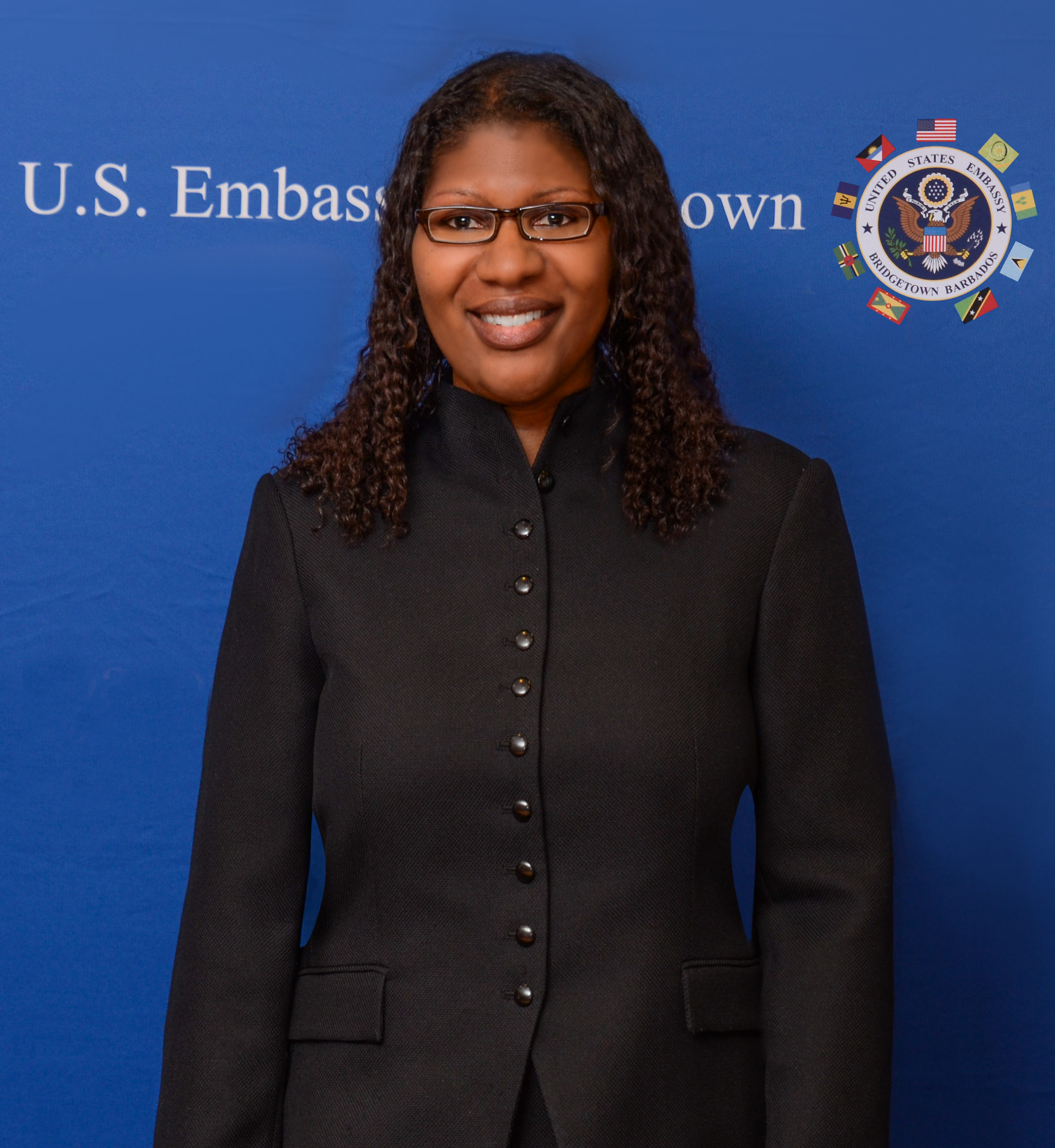
Public Affairs Officer at the US Mission to Barbados, the Eastern Caribbean and the Organization of Eastern Caribbean States, Kearney exhibited consummate skill in forging partnerships among alumni of the Bureau for Educational and Cultural Affairs, reinvigorating programs, cultivating new audiences, and establishing a broad base of influential contacts. Her innovative and forward-leaning social inclusion programs promoted equality for women, the LGBT community, those with disabilities, at-risk youth, and other marginalized persons. Her STEM programs have resonated throughout the eastern Caribbean, and, in support of President Obama’s educational initiative for the Americas, she facilitated agreements between US and Caribbean universities and organized college fairs.
In recognition of contributions over a distinguished 23-year career with the United States Information Agency (USIA) and the Department of State as Attorney-Advisor for Public Diplomacy in the Office of the Legal Advisor, providing consistently valuable and insightful advice in a time when the number and complexity of issues are growing steadily, Lorie Nierenberg was awarded the Ilchman-Richardson award. Her own experience as an exchange student in Germany has informed her guidance and the insights essential to producing Fulbright agreements that support US policy goals and meet bilateral priorities. In the 1990s, she played a central role in resolving the legal ramifications of merging USIA into State; this was an achievement of immeasurable importance, as her efforts created the structure that supports all the work now done by ECA every day. In 2022, Lorie Nierenberg was named the winner of the U.S. State Department’s Edward R Murrow for excellence in Public Diplomacy, the highest award in public diplomacy.
In recognition of her contributions over 38 years as Cultural Specialist at the US Embassy in Santiago, Chile. The programs she runs include traditional exchange programs, and long-term initiatives in justice, democracy, economics and social issues, many of which she created and sustained over decades. Focusing on legal reform, these programs helped move Chile’s inquisitorial justice system to one patterned largely on the US system. Her program alumni are everywhere in government, NGOs and civil society, innovating and reforming, inspired and encouraged by their ongoing contacts with her and the Embassy. The Chilean Congress recognized the impact of her work in a tribute read on the floor of the Senate.
Our April Portrait features Monica Alcalde, who won our Gill Jacot‐Guillarmod Award for Locally Engaged Staff in 2015. Monica, who has recently retired after forty years of service, writes: “My new life in the south of Chile is to work with my husband in an ecological adventure. We now live next to the Alerce Andino National Park in the Lake Region. I have changed my nice office clothing for jeans, boots and a warm jacket and look forward to new challenges and serving the community in this beautiful area of my country!”
One of three Roth Foundation awards honoring excellence in cultural diplomacy, our “Gill” Award was created in 2013 to recognize the invaluable contributions of locally engaged staff to US cultural diplomacy abroad. It is named in honor of Gill Jacot‐Guillarmod, who served for thirty-five years at the U.S. Mission in South Africa in a career that spanned—and contributed to—an era of change, from the dark days of apartheid through the peaceful emergence of democracy. Gill’s many admirers, who gathered together to fund this award, remember her as a consummate cross‐cultural communicator and bridge builder, who served so many as a mentor, counselor and committed senior colleague. Spearheaded by US foreign service officers in gratitude for the work of exemplary local colleagues, the “Gill” Award consistently garners so many nominations that last year we formalized offering an Honorary Mention. Read more about Gill and this award here.
Monica and her colleagues celebrate upon learning that she has received LRE’s “Gill” Award.
Monica Alcalde’s contributions as a cultural specialist at the U.S. Embassy in Santiago, Chile, began in 1976, when she was hired to be a translator during the visit of then-Secretary of State Henry Kissinger to Chile. Monica soon turned to working on programs in the domains of education, culture and policy. She recruited Chilean high school students to participate in three-week Youth Ambassador exchanges to the United States; thanks to her mentoring, many of these young people later attended colleges and universities in the U.S. Another of her initiatives focused on secondary schools, with a project teaching intellectual property rights via video game design, and the implementation of the US-based civic education program “Project Citizen.” With a keen eye for up-and-coming young leaders, Monica nominated numerous people who have become important political figures—including Chilean congressmen and -women, ministers and members of the Supreme Court—to participate in the U.S. International Visitors Leadership Program (IVLP) and other exchanges.
Perhaps the most profoundly influential domain of Monica’s work began in the early 1990s, as Chile transitioned to democracy after seventeen years under the Pinochet military dictatorship. As the country began to reform its judicial system, Monica worked tirelessly to provide helpful models and contacts from the U.S., approaching legal reform from all angles: as a human rights issue, as essential for strong democratic structures and civic engagement, as a means to address international organized crime and as a tool for both security and investment. In the 1990s, she sent over fifty Chilean judges and others to the U.S. on IVLP and other cultural exchange programs; from 1997 to 2002 alone, she hosted over twenty US speakers on justice.
In her last years at the Embassy, Monica focused her energies on women’s issues, working on: developing a Women Leading in Security and Justice Week in Santiago; creating the Women Entrepreneurs (WE) from the Americas Organization; and creating a series of fifteen nation-wide seminars entitled “Enterprising Women, Flourishing Societies,” with the Chilean Small Business Development Network.
Over two hundred alumni, friends and colleagues—including the Minister of the Interior, former Chilean Ambassadors to the U.S., legislators, judges, think tank directors and NGO leaders—were present at Monica’s retirement ceremony on December 15, 2016. Others sent warm greetings, including many US foreign service personnel who served in Chile. U.S. Ambassador Carol Perez closed her remarks at the ceremony by saying that Monica is someone that “one dreams of working with in an Embassy. In fact,” she continued, “Monica received the Lois Roth Foundation’s Gill Jacot-Guillarmod Award [at] the Department of State in Washington, DC. This is the highest award given to a locally employed staff member working in cultural diplomacy in any embassy or consulate in the entire world. She is simply the best.”
We agree! In closing, Monica writes: “I encourage all your readers to give generously to the Lois Roth Foundation and help support its work on behalf of international cultural dialogue on a human scale.”
——————————–
This profile, compiled by Board Secretary Anne Barbaro, draws heavily from the remarks of Ambassador Carol Perez at the Embassy’s retirement ceremony for Monica Alcalde.
In recognition of her masterful translation of Bill Bryson’s At Home: A Short History of Private Life (Une histoire du monde sans sortir de chez moi, éditions Payot-Rivages). Describing the volume, Marc Chénetier writes: “There is humor, immense erudition. There is delicacy, the abolition of expected distances: in time, in space, between an American and the English place he describes, between the translator and the malicious game of intertwined tonalities. Wit, play and elegance, cultured without pretention, funny, surprising: these qualities are shared by Bill Bryson and Hélène Hinfray…. You must read this history of the world, this curious voyage, this voyage of a curious man around his room … to realize that we do not really know how to look at or interrogate the things that surround us.”
His research in cultural anthropology looks at Indigenous media as an essential element for engaging and supporting some of the most culturally rich, yet vulnerable peoples of the world. In the Kimberley region of Australia, he explored the stakes involved in different Indigenous visions of Aboriginality by comparing two media organizations, following the social lives of their media through collaborating on production teams. His study reveals the changing diversity of Indigenous media in settler-colonial nations, as well as Indigenous challenges and perspectives in Australia and the U.S. Visit his website to learn more about his research, writing, films and podcasts.
This ninth of twelve portraits in 2017, honoring alumni from thirty years of Roth Foundation programs, features anthropologist William Lempert. Support from the Roth Foundation helped him carry out his work in the Kimberley region of northwestern Australia. William is now wrapping up his Ph.D. in Cultural Anthropology at the University of Colorado at Boulder. His dissertation is titled Broadcasting Indigenous Futures: The Social Life of Kimberley Aboriginal Media. Take a look at William’s website, featuring his articles, films and podcasts.
Project Support recipient William Lempert
My desire to become an anthropologist had many roots. The importance of understanding how historical legacies impact the present was instilled into me at a young age. Undertaking a series of interviews with my 92-year-old grandmother, I learned more about the personal history of her life and our family; although she lost most of her extended family in Nazi Germany, as a teenager she was able to save her parents from certain death at the Dachau concentration camp. My perspective expanded further when I undertook volunteer work in the aftermath of racial riots in my hometown of Cincinnati.
As an undergraduate, the interdisciplinary Western Program at Miami University in Oxford, Ohio gave me a chance to participate in a range of social and environmental programs in Brazil, Nicaragua, Kenya and Australia—leading to my honors thesis on the politics of popular Indigenous representations. Once I began graduate school, I discovered and cultivated a love of teaching, which continues to this day. In my teaching, I seek to engage students and broader audiences through a multifaceted approach to anthropology that integrates writing and media production.
During my first trip to the Kimberley region of Northwestern Australia in 2006, I learned about the inspiring ways that Aboriginal people are using media to transcend stereotypes and the mainstream media representations that represent their communities negatively, if at all. To prepare for my doctoral fieldwork, I returned to Australia for two summers as a media volunteer in the town of Broome and remote communities in the region. I was humbled by the palpable sense of joy and welcome that I felt from my Aboriginal collaborators, in spite of legacies of historical trauma and serious material and health disparities that continue through the present.
William (left) with Mark Moora, the Director of Tjawa Tjawa.
My dissertation project focuses on how Aboriginal Australians imagine and create their futures through the process of filmmaking. In the tradition of cultural anthropology, my approach centers on sustained participant/observation research. The project draws on my experience working within the production teams of two Indigenous media outlets. I worked on dozens of film projects with them, over a cumulative 26 months between 2006 and 2016. The primary film that I worked on—Tjawa Tjawa (2015)—screened at the Margaret Mead, ImagiNative and Sydney international film festivals.
I view collaborative media production as a framework, not only for re-imagining the relationships between anthropological practice, theory, and modes of representation, but also for an ethically-focused methodology. In my view, understanding the process of collective cultural production is essential, since culture itself is not pre-existing, but something that comes into being through doing. In particular, films emphasizing futurity—including such genres as science fiction—are particularly important for asserting Indigenous visual and temporal sovereignty.
My long-term goal is to facilitate community-partnered projects that transform how Indigenous challenges and futures are imagined by anthropologists, policymakers, and broader publics. Once my dissertation is finished, I look forward to developing an emerging research initiative on visualizing Aboriginal sign language and hearing loss, which evolved out of my work on film projects.
I am especially grateful to the Lois Roth Foundation for enabling me to attend a 2015 conference at the National Centre for Indigenous Studies at the National Australian University during my Fulbright research period. This was especially important, as it provided opportunities for mutual, extended engagement with Aboriginal and Australian scholars. In light of the complex challenges of our current global era, the Roth Foundation’s support of creative scholarship has never been more relevant.
———————————————-
“From remote communities, I have learned about the art of subtlety. There are often powerful things happening at a granular level. You can see a lot but miss everything. I think the more you see, the more you realise how much you are not seeing. For example, there are a myriad of little things about people who are interacting. You start to realise there are endless layers of social worlds that people live in. It’s quite an honour just to move into the first layer.” — William Lempert
This text evolved from correspondence between William Lempert and Skyler Arndt-Briggs. Thanks to Drew Barnhart, our Media and Outreach Manager,for producing our September Portrait.
In support of her research on African American and women’s history, specifically the history of African Americans in Denmark. Intended as a combination travel memoir and history, this work interweaves her own experiences in Denmark with the experiences of other African Americans who traveled, studied, and lived there during the last 100 years. Whitmire has published Regina Anderson Andrews: Harlem Renaissance Librarian (UIP, 2014) and is working on a book on Ethel Ray Nance (1899-1992), an African American/Swedish woman who broke racial barriers and worked with WEB Du Bois and Charles S Johnson.
Ethelene photographed in Lyngby in July 2017 by Vaughn Strother, an African American expatriate in Denmark
This eighth of twelve portraits in 2017, honoring alumni from thirty years of Roth Foundation programs, features a recent award winner. Ethelene Whitmire won our support for research she conducted in Denmark in 2015-16. She is a professor at the University of Wisconsin–Madison who focuses on American studies and African American women’s history. Here she recounts how she got interested in the project that took her to Denmark for a book on the experience of the important African American expatriate community there.
I became interested in my new book project, Searching for Utopia: African Americans in 20th Century Denmark, in a very unusual way. I first went to Denmark on a whim in May and June 2010. I was on the first sabbatical leave from my job as a university professor and was finishing my first book, Regina Anderson Andrews, Harlem Renaissance Librarian (2014). I wanted to go on a writing retreat in another country—and selected Denmark because I was watching a lot of Danish films at the time. I didn’t know anyone there. So I rented an apartment in the Christianshavn section of Copenhagen, met a ton of people… and I loved it! Since then, I have returned to Copenhagen twelve times, including every summer.
While renting an apartment in the Nørrebro neighborhood in the summer of 2013, I would take a shortcut through the Assistens Kirkegaard cemetery, where Hans Christian Andersen is buried. On the way back home one day, I encountered the grave of Ben Webster. I was curious about why a clearly non-Danish person was buried there. When I looked him up on the internet I was surprised to discover that he was a famous African American jazz musician and that there were several African American jazz musicians buried all over the city. During and between subsequent visits, I started gathering other information about African Americans who visited, lived, studied and performed in Denmark. I was intrigued and wanted to know more. Two research questions guided me: Why did African Americans go to Denmark? And what were their experiences while there?
Many have written books about African Americans in France, mainly in Paris; but the experience of African Americans in Denmark remains unexplored. So, about three years ago, I decided I would write a book on the subject. In 2015, I received grants from the American Scandinavian Foundation, which allowed me to conduct research and follow in the footsteps of the African Americans all over Denmark. I went to Kerteminde to see where painter William H. Johnson lived and worked. I caught the train to Helsingør to visit the archives at the International People’s College, where many African Americans went in the 1930s to study the Danish folk school and cooperative movements. I searched through the archives of expatriates at the Royal Danish Library and in the Danish National Archives.
This research represents a very new direction for me—one I feel very passionate about. Formerly, I was an administrator in higher education working at Rutgers University in New Jersey, during which time I earned a master’s degree in Library Service. I left Rutgers to pursue a PhD in Higher Education at the University of Michigan, after which I became a professor in the field of Library and Information Studies at the University of Wisconsin–Madison. While conducting an ethnographic study of African Americans in public libraries in Los Angeles, supported by a Ford Foundation fellowship, I came across an article about African American librarians in New York City during the Harlem Renaissance.
Fascinated, I then researched and wrote a book on the librarian Regina Anderson Andrew. This introduced me to the field of African American history and my interest in archival research and recovery work—uncovering the stories of people lost to history. One of the things that interested me in Andrews’ life—aside from her being an actress and playwright during the Harlem Renaissance—was that, as a representative of a civic organization called the National Council of Women of the United States, she travelled abroad to Germany, Brazil, Asia, the Middle East and several Western African nations. This got me very curious about the transnational experiences of African Americans.
Upon returning from my summer 2015 research trip to Denmark, I was delighted and surprised to learn that I had been awarded a Project Support award from the Lois Roth Foundation. This allowed me to return to Denmark the following January to do additional research—including interviews with the widows and children of certain expatriates. The recognition and support represented by this Roth Foundation award was key in helping me earn a Fulbright award to return to Denmark in fall 2016.
That semester, I was a visiting scholar at the University of Copenhagen’s Center for Transnational American Studies and gave a keynote address at a university symposium on “Denmark and African American Culture.” At that symposium, I met an earlier recipient of a Roth Foundation award—Heidi Durrow, author of the novel The Girl Who Fell From the Sky, was the other keynote speaker! Receiving the support of ASF and the Roth Foundation opened doors; my Fulbright year then gave me great opportunities to share my work. During the 2016-2017 academic year, I ended up presenting talks not only at other venues in Denmark, but also in South Africa and Austria… and this fall I will bring it back to the U.S., in an October talk at the conference of the Danish American Heritage Society in Schaumburg, Illinois.
Ethelene and Heidi Durrow at the University of Copenhagen’s symposium on “Denmark and African American Culture”
This text evolved from a written interview with Ethelene Whitmire conducted by Skyler Arndt-Briggs. Thanks to Drew Barnhart, our Media and Outreach Manager, for producing our August Portrait.
Taylor Tyger (Georgia Institute of Technology) conducted research on the health benefits of urban aquatic environments. She was based at the Finnish Environment Institute, at Aalto University, and worked as part of an ongoing national project focusing on “Environmental Justice and Ecosystem Services” in the Helsinki region. She presented her findings on the little-studied “blue infrastructure” of lakes, oceans and rivers in a report on Waterfront Uses in the Helsinki Metropolitan Area. Her Roth-Thomson Award allowed her to present this work at conferences in Belgium and Denmark in May 2015.
Based at the Arctic Center in Rovaniemi, Michael Brown (University of Washington) sought to evaluate Finland’s new arctic policy in order to construct a comparative assessment of Finnish and US approaches to environmental issues in the arctic. This project is timely, as the U.S. is currently chairing the Arctic Council (2015-17), after which Finland will take up the reins. Brown’s Roth-Thomson Award allowed him to join the University of the Arctic’s Calotte Academy, a travelling symposium that in 2015 met at research centers in Finland, Norway and Russia.
The award went to accomplished translator Patrick Phillips, the director of Creative Writing at Drew University, for research on a new English translation of Knud Holmboe’s memoir Orkenen Brænder – The Burning Desert. This volume recounts the journalist’s drive across the Sahara in 1930, during which he witnessed atrocities against the Bedouin people and an attempted genocide by the colonial Italian government. Read an interview with Patrick here and visit his website to learn about all his publications to date.
This third of twelve portraits in 2017, honoring alumni from thirty years of Roth Foundation programs, features noted author Patrick Phillips. You can read about all his publications to date at www.patrickthemighty.com!
Patrick won a Project Support Award to Denmark in 2014 to help him undertake research for his next book project. He teaches creative writing, literature and literary translation at Drew University, where he also directs the Creative Writing Program. The winner of many fellowships and honors, Patrick has published three volumes of his own poetry—the most recent of which, Elegy for a Broken Machine, was a finalist for the National Book Award—and translated a volume of poetry—When We Leave Each Other: Selected Poems of Henrik Nordbrandt—from the Danish.
Author Patrick Phillips
If Patrick’s name seems familiar to you, however, it may be for his first book of nonfiction, Blood at the Root: A Racial Cleansing in America, which has been garnering a great deal of attention, including in a PBS Newshour piece that aired on Martin Luther King Jr. Day. In gripping prose, the volume chronicles the tragic history of Forsyth County, Georgia, where Patrick grew up. While lynching was not uncommon in Georgia in the early 20th century, the 1912 murder of a white girl in Forsyth led to a coordinated campaign of arson and terror that drove all 1098 black citizens from the county. In the wake of the expulsions, whites harvested the crops and took over the livestock of their former neighbors, quietly laying claim to “abandoned” land. Building on his own childhood experience, Patrick documents the violent means by which locals kept Forsyth “all white” well into the 1990s.
In retrospect, the publication of Blood at the Root sheds a new light on Patrick’s next project, which he researched in Denmark in summer 2014: a new English translation of journalist Knud Holmboe’s Orkenen Brænder (The Burning Desert). Holmboe’s memoir recounts his drive across the Sahara in 1930, during which he witnessed atrocities against the Bedouin people and an attempted genocide by the colonial Italian government. In his project description, Patrick noted: “As a convert to Islam and one of the first Europeans to live and travel among the Bedouins, Holmboe offers us a rare, ground-level look at the brutal mechanisms of colonial power, as well as a voice of dissent too often lost to history.”
This month, Patrick was gracious enough to share a few thoughts about his work with us. (Read the entire interview on our website.) Here are some excerpts:
“I think my two prose projects are deeply related, in that they both grew out of my fascination with hidden history: shocking, monumental, and once widely-known events that over the course of time have been erased. Both books are accounts of atrocities: Blood at the Root tells of the expulsion of the entire African American community of Forsyth County, Georgia, where I was raised, and The Burning Desert documents the attempted genocide of Bedouin people by the colonial Italian army.
“As far as chronology, I have been thinking about the story of Forsyth County’s black community since I was seven years old. I started actively researching the book about a decade ago. During this same period I learned about The Burning Desert from a writer and translator named Andre Naffis-Sahely, who knew many Moroccans who revere Holmboe for telling the world about the genocide in North Africa—a bravery that cost Holmboe his life. Andre reached out to me in hopes that a new translation could bring fresh attention to the book and to that history.
“What links the two projects, beyond the appalling crimes committed against vulnerable people, is that both events have been almost totally erased from our consciousness. So a common goal of both Blood at the Root and my translation of Holmboe was to bring a buried history back to the surface. History is written by the victors, as they say, and so I wanted both books to counter that, by telling the story of the victims, and reversing that process of erasure and historical amnesia.
“I should also add that these connections are something I see only in hindsight! At the time, I was simply following my curiosity and trying to make myself useful. But clearly one project was influencing the other, and I have no doubt that I was deeply influenced by Holmboe’s drive to expose an atrocity—and to honor the dead by telling their stories.
“The support of the Roth Foundation was absolutely essential to my work on Holmboe, particularly because it came during the very early stages of the project. The grant I received from the Endowment helped support a month I spent in Copenhagen, where I got my conversational Danish back up to speed; spent time in the Kongelige Bibliotek reading Holmboe’s work as a journalist; and devoted long days to translating the text of The Burning Desert.
“Translation is always a labor of love, and that means the translator can often feel very lonely: like the only person in the world who cares about a given author or text, and like someone laboring for very little reward and attention. But receiving a grant meant that for the first time I could take my own interest in Holmboe seriously. Someone else had given that work a vote of confidence and a push forward, which meant the world to me. So everyone at the Roth Foundation has my deepest gratitude!
“To me, the message of the award was simple but absolutely vital: keep going.”
——————————-
This alumni portrait was drafted by Roth Foundation chair, Skyler J. Arndt-Briggs, based on a short interview with Patrick Phillips. Thanks to Drew Barnhart, our Media and Outreach Manager, for producing this third 2017 alumni portrait!
Interview With Author Patrick Phillips
Conducted by Skyler J. Arndt-Briggs, March 2017
SAB: I am curious about the relationships, if any, that exist for you between your two nonfiction projects, Blood at the Root and the translation of Knud Holmboe’s Burning Desert. How are the two projects related chronologically? Were you working on Blood at the Root when you came upon and decided to translate Holmboe’s memoir?
PP: I think that the two projects are deeply related, in that they both grew out of my fascination with hidden history: shocking, monumental, and once widely- known events that over the course of time have been erased. Both books are accounts of atrocities: Blood at the Root tells of the expulsion of the entire African American community of Forsyth County, Georgia, where I was raised, and The Burning Desert documents the attempted genocide of Bedouin people by the colonial Italian army.
As far as chronology, I have been thinking about the story of Forsyth County’s black community since I was seven years old, and actively researching the book for about a decade. During this same period I learned about The Burning Desert from a writer and translator named Andre Naffis-Sahely, who knew many Moroccans who revere Holmboe for telling the world about the genocide in North Africa—a bravery that cost Holmboe his life. Andre reached out in hopes that a new translation could bring fresh attention to the book and to that history.
SAB: While both Blood at the Root and Burning Desert demand a historical archaeology, the former was clearly a personal project for you (rooted in your years in Forsyth as a young person), while Burning Desert recounts events that took place half a world away. Do you feel that similar or different things drew you to each project?
PP: I love that phrase “historical archaeology,” and that’s very much what I felt I was doing in both cases. What links the two projects, beyond the appalling crimes committed against vulnerable people, is that both events have been almost totally erased from our consciousness. So a goal common to both Blood at the Root and my translation of Holmboe was to bring a buried history back to the surface. History is written by the victors, as they say, and so I wanted both books to counter that, by telling the story of the victims, and reversing that process of erasure and historical amnesia.
I should also add that these connections are something I see only in hindsight! At the time, I was simply following my curiosity and trying to make myself useful. But clearly one project was influencing the other, and I have no doubt that I was deeply influenced by Holmboe’s drive to expose an atrocity—and to honor the dead by telling their stories.
SAB: As an accomplished poet, how does it feel to be working on these two major prose works? Do you feel you get different things out of each form? Or that each brings out different things in you?
PP: Because I have spent most of my adult life working as a poet, I struggled to believe that I could write a long-form book of nonfiction, or translate one. But in the face of that self-doubt, the best thing is to simply carry on: to keep working every day and try to ignore all the questions about whether it will add up to something.
Instead, I taught myself how to write prose as I was working, and I do think that translating Holmboe’s writing was a great boost to my confidence. The wonderful thing about translating is that the translator gets to write without having to invent. You get to work out all the mental muscles that shape precise, elegant sentences, but are freed from the anxiety of what to say.
I think all those years I labored in the fields of poetry were also invaluable, in that poetry teaches compression, concision, and the power of the singular, well- chosen detail. Now that I’ve worked in prose and poetry, I think the distinctions we draw between them are much more professional than they are actual. I have come think of myself as a writer rather than exclusively a poet, and it is thrilling to feel that I can range into some new territory without anxiety about genre. It was also a joy to do something new because I have a short attention span and am very easily bored!
SAB: I know that you have received the support of many organizations and fellowships, so I’m sure that our small contribution to your work did not stand out. But, if there is anything you could say, we would love to hear any thoughts you might have regarding the work and mission of the Lois Roth Foundation.
PP: The support of the Roth Foundation was absolutely essential to my work on Holmboe, particularly because it came during the very early stages of the project. The grant I received from the Endowment supported a month I spent in Copenhagen, where I got my conversational Danish back up to speed; spent time in the Kongelige Bibliotek reading Holmboe’s work as a journalist; and devoted long days to translating the text of The Burning Desert.
Translation is always a labor of love, and that means the translator can often feel very lonely: like the only person in the world who cares about a given author or text, and like someone laboring for very little reward and attention. But receiving a grant meant that for the first time I could take my own interest in Holmboe seriously. Someone else had given that work a vote of confidence, and a push forward, which meant the world to me. So everyone at the Roth Foundation has my deepest gratitude!
To me, the message of the award was simple but absolutely vital: keep going.
*The Prix Coindreau Prize, The Jeanne Varnay Pleasants Prize for Language Teaching, and the CASVA-Henry & Judith Millon Award are currently inactive.















 Fascinated, I then researched and wrote a book on the librarian Regina Anderson Andrew. This introduced me to the field of African American history and my interest in archival research and recovery work—uncovering the stories of people lost to history. One of the things that interested me in Andrews’ life—aside from her being an actress and playwright during the Harlem Renaissance—was that, as a representative of a civic organization called the National Council of Women of the United States, she travelled abroad to Germany, Brazil, Asia, the Middle East and several Western African nations. This got me very curious about the transnational experiences of African Americans.


